Visit
Visit
 Explore
 Education
 Stories
 About us


Celestial globe: navigating the stars
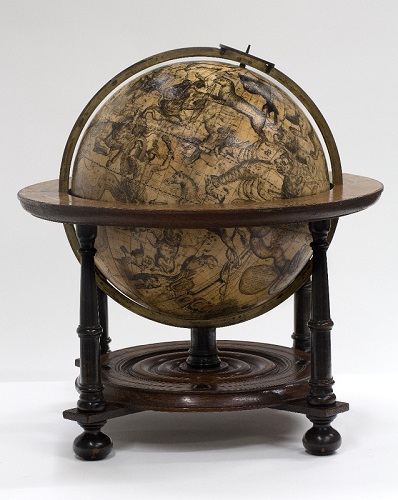
Globe filled with constellations
This celestial globe from 1711 shows a detailed map of the night sky as it was known then. The globe shows where stars and constellations are in the sky. But whether such a globe really helped in making distant journeys remains to be seen.
Even well before the seventeenth century, ship captains were using the stars to find their way at sea. By looking at the position of stars and planets, they could determine where they were. When cartography began to develop greatly in the Netherlands, this knowledge was increasingly recorded.
Accurate celestial globes
With the invention of the telescope in the seventeenth century, sailors were able to observe even more stars and better record their positions. Captains and helmsmen were instructed during their voyages to record observations of celestial bodies. This information was used by cartographers, who were thus able to create increasingly accurate maps and globes.
The Dutch cartographer Gerard Valck made several celestial globes at the beginning of the eighteenth century based on these new insights. The 1711 celestial globe you see in the Muiderslot is an example. It probably also included an earth globe, as globes were usually sold as a pair.
Awkward size
Although helmsmen contributed much to the development of globes, they themselves rarely used them on board. Globes had an awkward size, were fragile, and the chart image was often not detailed enough for navigation at sea.
In a 1667 document, a mapmaker for the United East India Company (VOC) wrote that the globes were unused in the warehouse: “There were 16 globes, most of them decayed and eaten by cockroaches.
However, globes were used in the training of future sailors. Using earth and sky globes, they learned how the earth, sun and stars related to each other. Using a globe was not easy: therefore, one received a comprehensive handbook upon purchase.
Globes to show off
Among helmsmen, then, globes were not very popular. Among the wealthy, however, they were. In the seventeenth and eighteenth centuries, earth and sky globes became true status symbols. Kings, admirals and wealthy citizens liked to be portrayed with a globe. Even P.C. Hooft (writer, historian and resident of the Muiderslot) had his portrait made with a celestial globe. Such a globe symbolized knowledge, science and worldly wisdom. The choice of a celestial globe instead of an earth globe could also refer to God and the higher. So in the seventeenth and eighteenth centuries, a globe was more often used to impress than to actually navigate with.
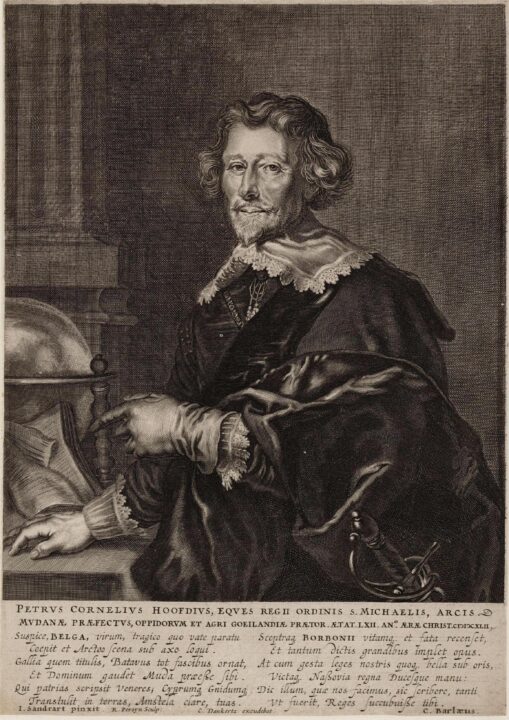
Petrus Cornelius Hooft (1581-1647), drost of Muiden with his world globe. Engraving, 1642. Amsterdam City Archives Collection

In this video, Render Storm, curator of cartography at the Allard Pierson, explains how our celestial globe went with us at sea